 Before & After
Stop 1 · Cathedral Hill
The Joseph McKey House
235 Summit Avenue, Saint Paul
One of the last 1870s frame houses left on lower Summit, standing in the shadow of the Cathedral for nearly 150 years.
View This Stop

Presenting Painting Sponsor of the Historic Hills House Tour
Walk five landmark homes we painted, see what a record year on the Hill looked like, and be first to know about 2027.
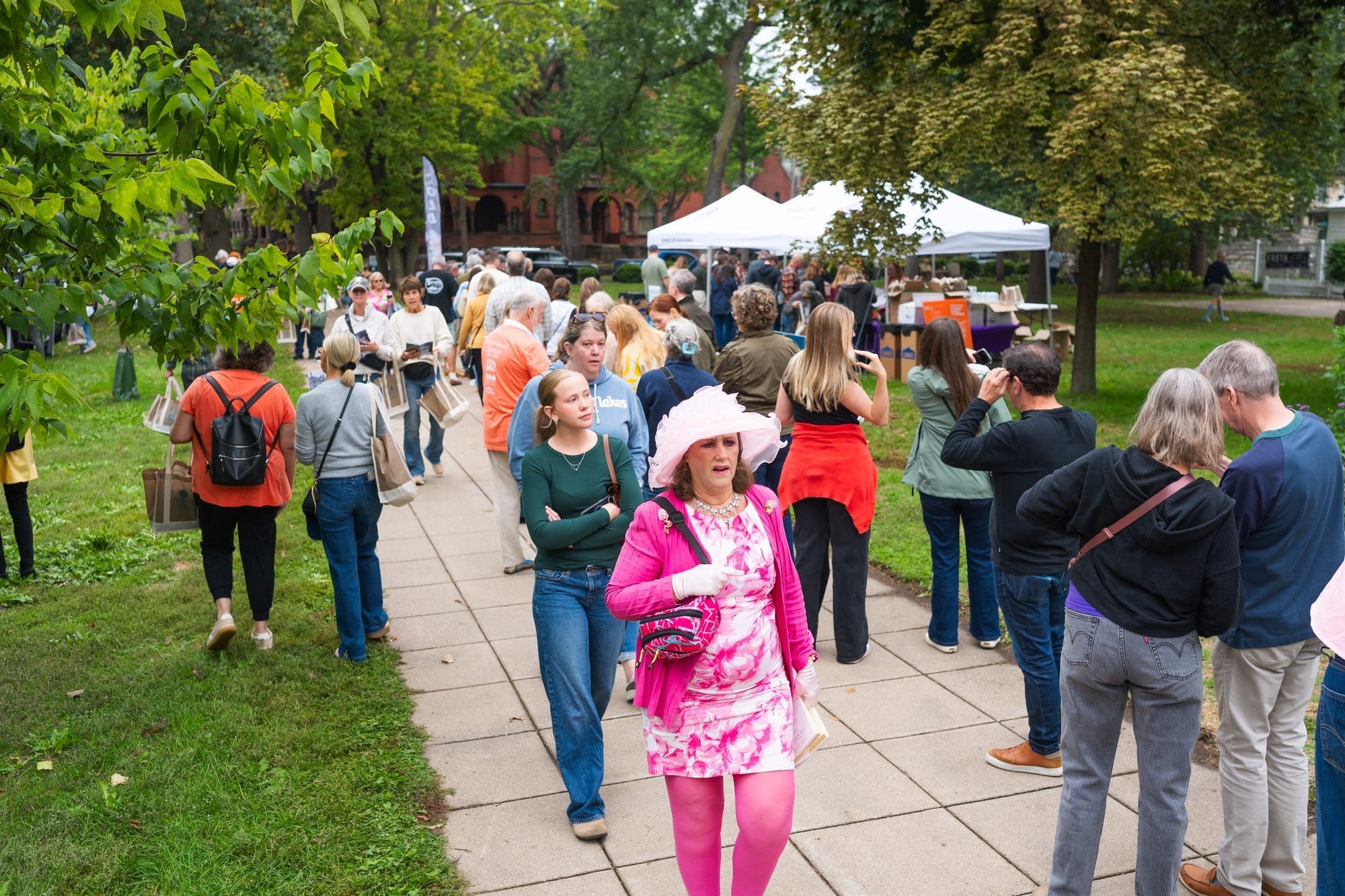
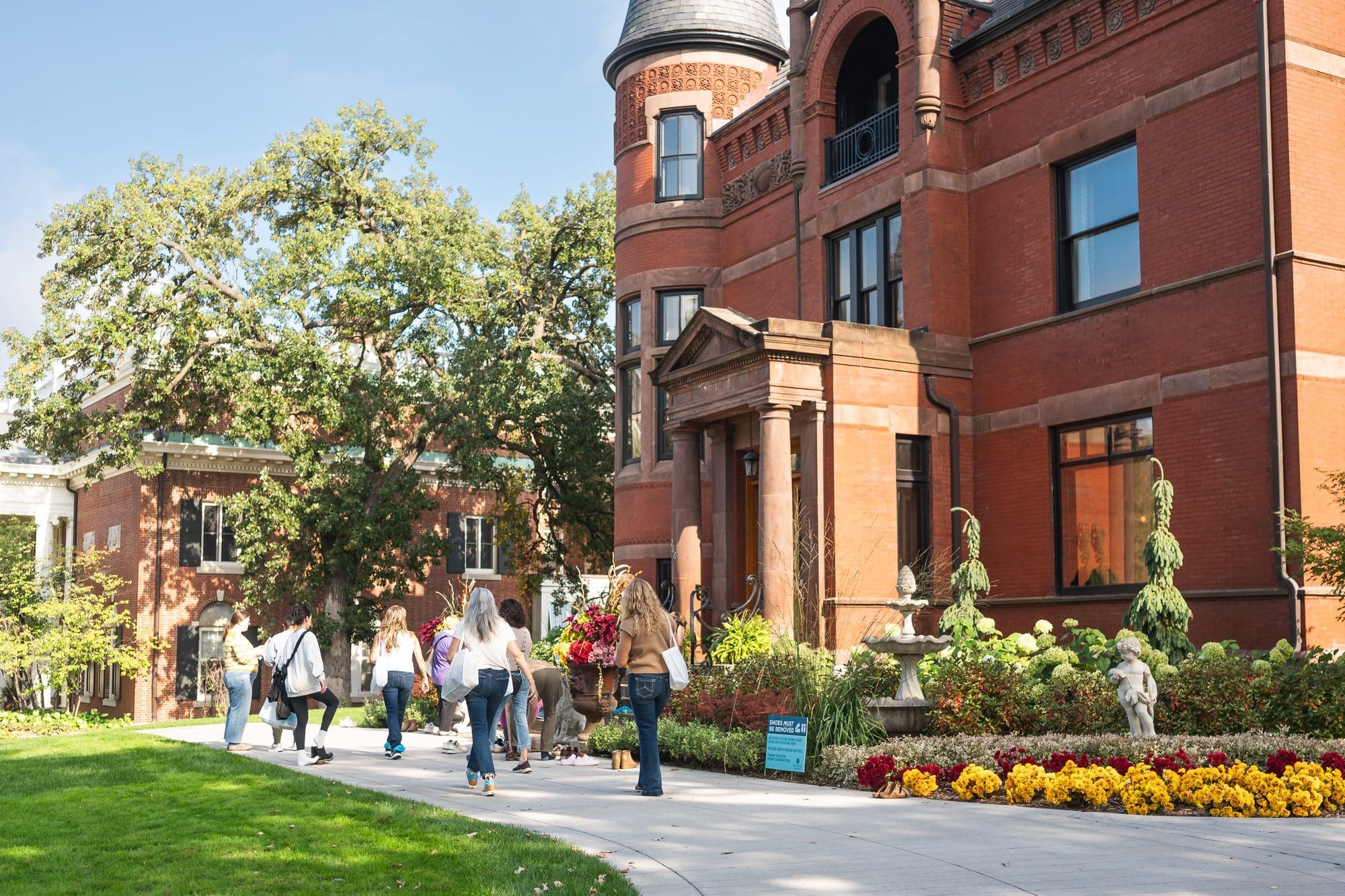
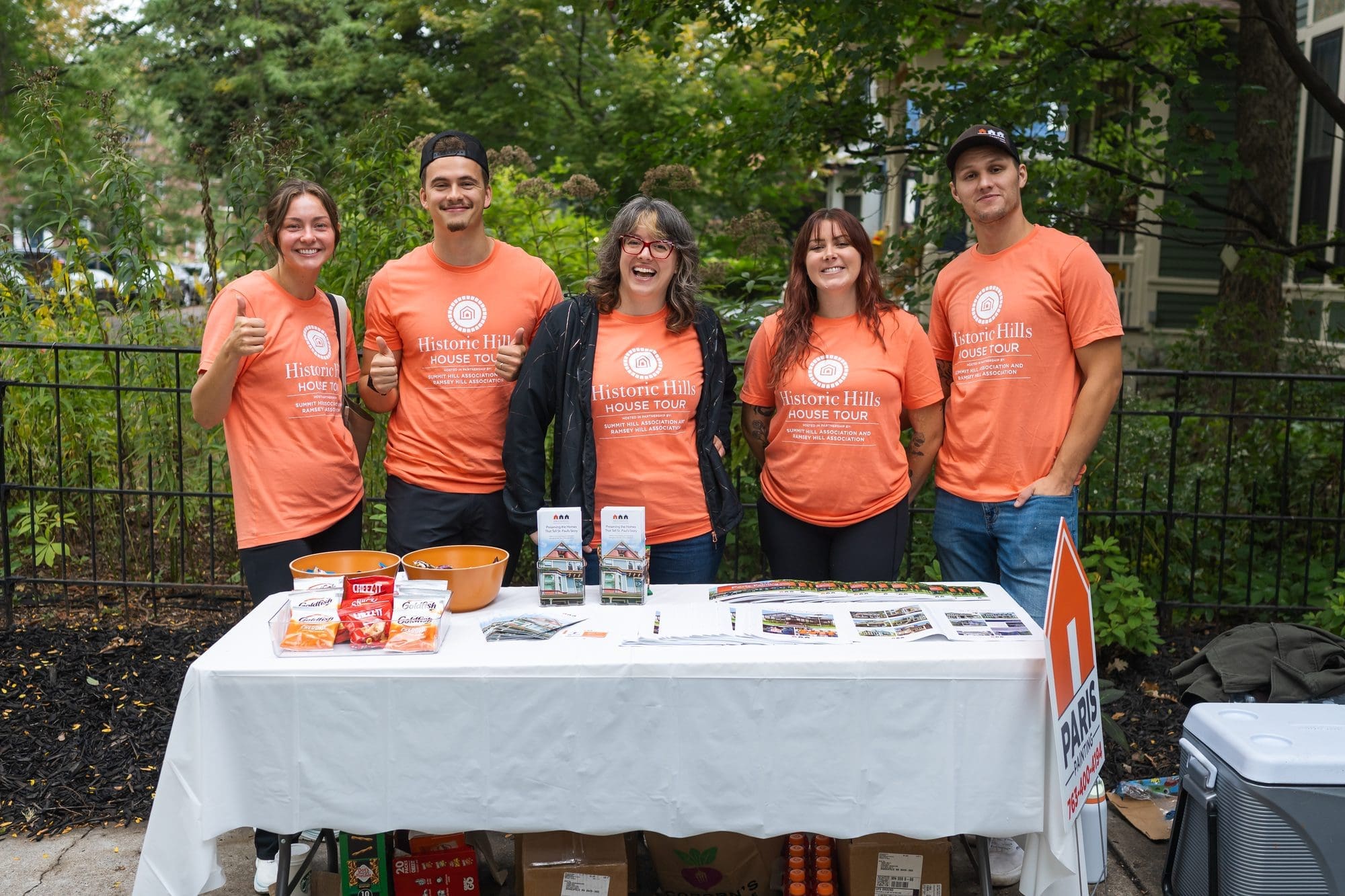
On Sunday, September 27, more than 2,800 people walked Summit Hill and Ramsey Hill together, the biggest turnout in the tour's history. Porches were full, sidewalks were full, and two of the homes on this page, the purple Victorian at 110 Virginia Street and the Frank B. Kellogg House, opened their doors. Thank you to the Summit Hill and Ramsey Hill Associations, the homeowners who shared their houses, the volunteers in orange, and everyone who came out to celebrate the homes that tell Saint Paul's story.





Get notified about the next Historic Hills House Tour, ticket giveaways, and the occasional story from a Saint Paul home worth knowing. One form, no spam.
The Historic Hills House Tour is presented by the Summit Hill and Ramsey Hill Associations. Paris Painting is the Presenting Painting Sponsor.
The Historic Hills House Tour opens Saint Paul’s grandest homes one Sunday each fall. This walk keeps five of them open all year, from the Cathedral west through Cathedral Hill, Woodland Park, Summit Hill and Crocus Hill.
Open any stop for the home's story and the care it received. Apart from tour day at the featured homes, these are private residences. Please enjoy them from the sidewalk.
Before & AfterStop 1 · Cathedral Hill
The Joseph McKey House
235 Summit Avenue, Saint Paul
One of the last 1870s frame houses left on lower Summit, standing in the shadow of the Cathedral for nearly 150 years.
View This Stop Opened on the 2026 Tour
Stop 2 · Cathedral Hill
The Purple Victorian
110 Virginia Street, Saint Paul
A quiet gray house became Cathedral Hill's boldest transformation, planned on an architect's rendering and painted to match it.
View This Stop
Stop 3 · Woodland Park
496 Marshall Avenue
496 Marshall Avenue, Saint Paul
A seven-color Queen Anne on the avenue Governor William Rainey Marshall platted and named in 1856, in the Woodland Park Historic District.
View This Stop
Stop 4 · Summit Hill
The C.C. Andrews Residence
833 Goodrich Avenue, Saint Paul
A six-color painted lady, said to have been home to the Civil War general who became the father of Minnesota forestry.
View This Stop Opened on the 2026 Tour
Stop 5 · Crocus Hill
The Frank B. Kellogg House
633 Fairmount Avenue, Saint Paul
Home for 48 years to the U.S. Secretary of State who won the Nobel Peace Prize, and one of the homes that opened its doors on the 2026 tour.
View This StopEvery home on this tour was painted under the same set of rules. The ones a hundred-year-old house insists on. They are the standards behind our historic exterior painting work across Saint Paul.
Full lead-safe prep procedures on every substrate tested or assumed positive for lead paint, and we never sand lead paint: loose paint is hand-scraped under plastic containment and the chips are HEPA-vacuumed and disposed of per EPA rules.
Soft washes and lead rinses, never high pressure. Historic siding gets cleaned for adhesion, not blasted.
Slow-dry oil and high-build bonding primers chosen to strengthen aged wood, calm thermal stress, and lock down generations of paint.
Six- and seven-color Victorian schemes matched from chips, buckets and physical samples painted on the house, and refined with the homeowner's color specialist or architect.
The 2026 tour is in the books. The Summit Hill and Ramsey Hill Associations bring the tour back every fall, and we will be there again as Presenting Painting Sponsor. Sign up and you will hear about dates, homes and giveaways before anyone else.
“We needed a company that understood older homes and could preserve the history and detail of our Victorian. Paris Painting did a great job, and we now see their work throughout the neighborhood.”
Ann & Bruce, Homeowners at Stop 4
Stop 1 of 5 · Cathedral Hill
235 Summit Avenue, Saint Paul
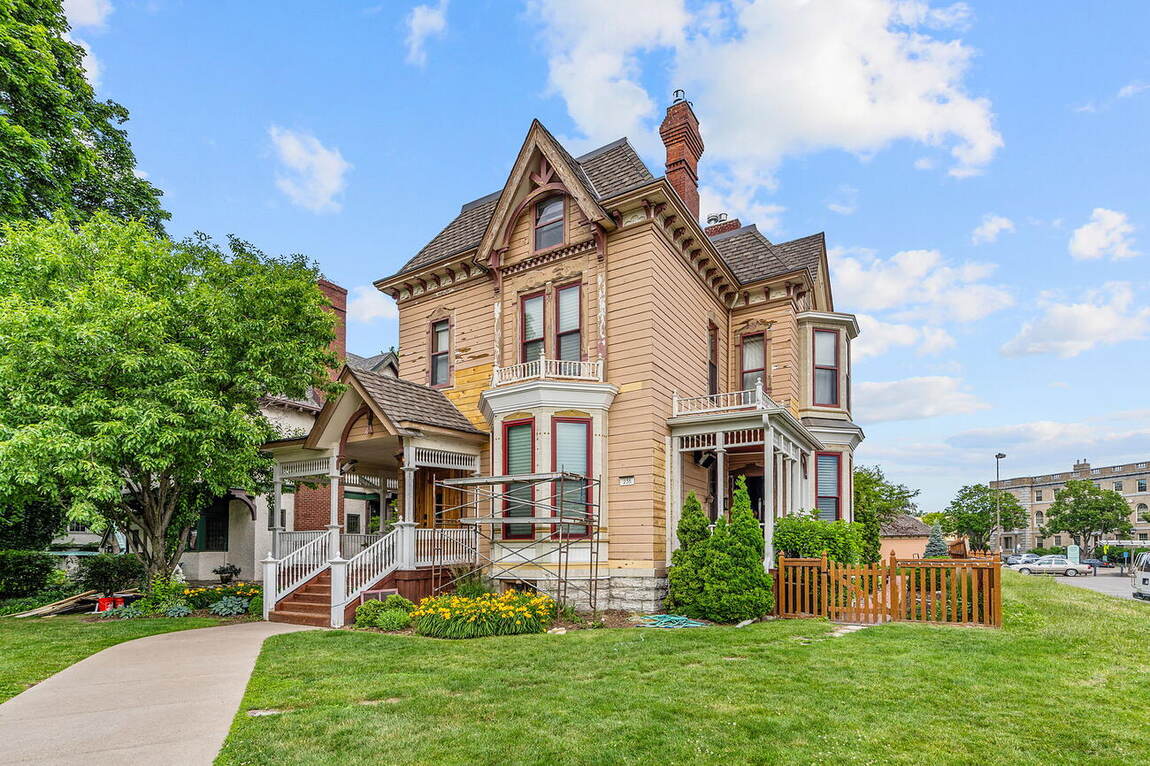
Lower Summit near the Cathedral is the avenue's oldest ground, and the stretch where the first generation of houses was most often torn down to make way for the masonry mansions that stand there now. This two-story frame house, built in 1879, is one of the few that survived. The National Register nomination for the Historic Hill District names it the Joseph McKey House and describes it as Italianate, with bracketed cornices and gables and, unusually, panels carrying a Gothic trefoil motif. The original brackets and limestone foundation are intact.
City directories record its first owner as Charles Noyes, a druggist whose shop sold ginseng, seneca roots and beeswax. From 1882 to 1896 it was the home of Joseph McKey, whose Boston One Price Clothing House was a fixture of downtown Saint Paul retail. The house is a contributing property of the Historic Hill District, listed on the National Register in 1976, and stands directly across Summit Avenue from the James J. Hill House.
Working alongside restoration contractor MN Crown Exteriors, we repainted the exterior in a five-color scheme matched to the home's existing palette. Drag the slider to compare before and after.
Painted by Paris Painting, Official Painting Partner of the Historic Hills House Tour.
Stop 2 of 5 · Cathedral Hill
110 Virginia Street, Saint Paul
Opened its doors on the 2026 tour. This home welcomed visitors on the Historic Hills House Tour, and the homeowners' architect, whose rendering guided the repaint, walked them through the color story.


Virginia Street climbs north off Summit Avenue through the heart of Cathedral Hill, anchored at Selby by the 1887 Virginia Street Church, an early commission of Gilbert and Taylor, Cass Gilbert's first firm, before he went on to design the Minnesota State Capitol. The street's houses went up in the 1880s building boom. Ramsey County carries no recorded build date for this one, and the district survey does not single it out, so we date it to the decade rather than the year. It rises three stories, with a porte cochere, leaded glass at the door, and original woodwork and fireplaces within. No architect is recorded for the original house, and its builder remains anonymous.
For years the house wore quiet gray. The current owners saw something bolder. Working with their architect, they developed a full color study of the exterior, rendered in three dimensions before a brush was lifted, and asked us to bring it to life: deep purple siding, crisp white trim, black accents. Both the home and its architect will be part of this year's Historic Hills House Tour, where you can judge the resemblance yourself.
A whole-house repaint that turned a rendering into reality.
Painted by Paris Painting, Official Painting Partner of the Historic Hills House Tour.
Stop 3 of 5 · Woodland Park
496 Marshall Avenue, Saint Paul
William Rainey Marshall arrived in Saint Paul in 1849. He was a hardware merchant, banker and newspaper publisher, a Civil War colonel of the 7th Minnesota brevetted brigadier general, and from 1866 to 1870 the fifth Governor of Minnesota. In 1856 he platted Marshall Avenue as part of Mackubin and Marshall's Addition. Local accounts associate this Queen Anne on that same avenue with Marshall in the years before he left for California in 1894, though his one documented Saint Paul house is the one he built at 415 Summit Avenue in 1880, and we have not found a primary record placing him here. We tell the story as the neighborhood tells it, and note the gap.
The National Register inventory for Woodland Park lists the house as a pivotal building of the district, singling out its polygonal corner tower, second-story spindlework portico, ornately carved pediment above the half-front porch, and banded shingle work. Its near-twin next door at 492 Marshall was built the same year by the same hand. Ramsey County records the house as built in 1884; other sources give 1891. We show the decade.
The proposal said it plainly: this project is not for the faint of heart. A seven-color Victorian scheme across three stories of towers, shakes and spindlework, assigned to one of our most experienced crews.
Painted by Paris Painting, Official Painting Partner of the Historic Hills House Tour.
Stop 4 of 5 · Summit Hill
833 Goodrich Avenue, Saint Paul
Goodrich Avenue runs through the heart of Summit Hill, the streetcar-era neighborhood of merchant and professional-class Victorians one block south of the Summit Avenue mansions. This 1891 Queen Anne is said to have been the residence of General Christopher Columbus Andrews: Civil War brevet major general, U.S. Minister to Sweden and Norway, and, after the Hinckley Fire of 1894, Minnesota's first Chief Fire Warden. Remembered as the father of Minnesota forestry, he was instrumental in the creation of the Superior National Forest, and the C.C. Andrews State Forest bears his name. He died in Saint Paul in 1922. The Historic Hill District nomination lists him among the influential residents who moved to the Hill but does not name his house, and neither does any record we have found; the link to 833 Goodrich rests on local tradition.
The street kept good company. In the early 1920s, F. Scott and Zelda Fitzgerald were renting just down the block at 626 Goodrich. No architect is recorded for the house. Its shake-work gables and shingle ornament speak for themselves.
A true painted-lady treatment: six colors across lap siding, two patterns of shake, and gables that carry five colors on their own.
Painted by Paris Painting, Official Painting Partner of the Historic Hills House Tour.
“We needed a company that understood older homes and could preserve the history and detail of our Victorian. Paris Painting did a great job, and we now see their work throughout the neighborhood.”
Ann & Bruce, the homeowners
Stop 5 of 5 · Crocus Hill
633 Fairmount Avenue, Saint Paul
Opened its doors on the 2026 tour. This National Historic Landmark welcomed visitors on the Historic Hills House Tour.
Built around 1889 in rock-faced sandstone with granite and brownstone trim, this Queen Anne and Romanesque landmark was the permanent home of Frank B. Kellogg for nearly half a century, from 1889 until his death here in 1937. Kellogg was the trust-busting lawyer who prosecuted Standard Oil for Theodore Roosevelt, Minnesota's first popularly elected U.S. Senator, Ambassador to Great Britain, and U.S. Secretary of State under Calvin Coolidge. For the Kellogg-Briand Pact of 1928, ultimately signed by more than sixty nations renouncing war, he received the 1929 Nobel Peace Prize. Kellogg Boulevard downtown carries his name.
President Coolidge was a guest here in the 1920s, and the addition built in that era is still called the Coolidge Wing. The carriage house behind the home was converted by Kellogg himself for the automobile age, and his auto turntable remained inside decades later. The house is one of a handful of properties in Saint Paul designated a National Historic Landmark.
A painting project on a National Historic Landmark leaves no room for shortcuts. The work was planned in two phases around the one window of scaffold access to the home's highest peaks.
Painted by Paris Painting, Official Painting Partner of the Historic Hills House Tour.